
Quarterly Member Spotlight
2026, Quarter 2
Describe your career as a music therapist – education, populations served, etc.
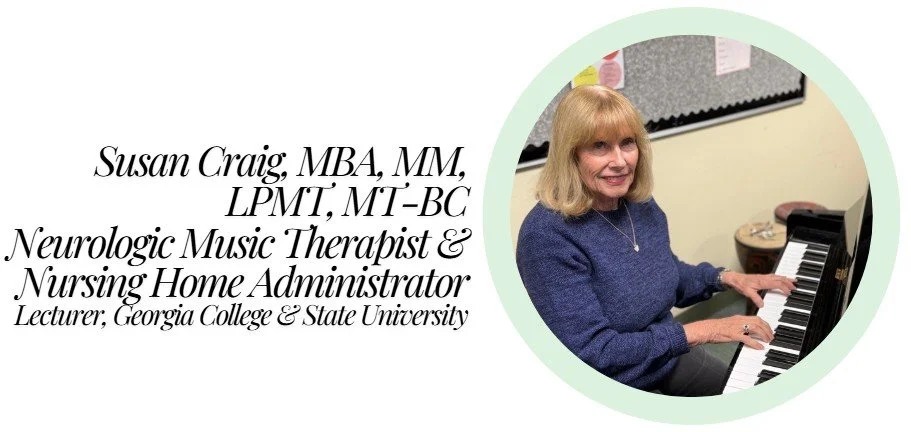
I have a degree from University of Maryland Baltimore County with a double major in Psychology and in Music with an emphasis in Piano. I went to The Florida State and received the Masters Equivalency Degree in Music Therapy. I received a Master of Business Administration (MBA) from Georgia College and State University. I am certified in Neurologic Music Therapy. I am a Licensed Nursing Home Administrator and I am Board Certified in Music Therapy.
I interned at Central State Hospital in Milledgeville Georgia and worked with a variety of populations: Children and Adolescent, Intellectual Developmental Disabilities, Mental Health, Alcohol and Drug and Geriatrics. My career began at Central State Hospital in Milledgeville Georgia when we had 800 individuals in the Developmental Disabilities Division. I worked as a music therapist for two years and had small group sessions of eight or less people and large group sessions (45 people in a session). I played the organ and piano for many funerals and other services that were held at the Division level. I became a Team Leader and later the Nursing Home Administrator for several Units within the Division. During the time as an Administrator, I taught the staff how to work with the Individuals using various reinforcement techniques. I used my music therapy skills and produced several Christmas and Spring shows for the Clients at the hospital. The performers were Clients/Individuals and staff from various Divisions in the Hospital and individuals from the community. We frequently performed for the Governor’s wife and several dignitaries during the Annual Mayor’s Motorcade as well as for the clients and staff at the Hospital. Our performances filled the large auditorium. We closed the last building in the Developmental Disability Division in 2015. In 2015 I began to work in the community in a day program and also in a residential setting.
I began my teaching career at Georgia College in 2012 when I was asked to supervise Practicum Students in the local schools. I was later asked to teach Piano for Therapists and that led to teaching Instrumental Survey as an Adjunct Professor. I have been teaching a variety of classes since 2019 and I am now a Permanent Part-Time Professor.
What brought you to the field of music therapy or why did you decide to pursue music therapy as a profession?
I began to write plays when I was about 13 years old and we would perform at local camps in the County, and in the neighborhood. I worked with people who had Developmental Disabilities and I saw how the individuals responded to the costumes, the drama, the acting and the music. I had the desire to work with people who had an Intellectual Developmental Disability and I found out about the Music Therapy Field through a Social Work Professor at the Kennedy Center in Baltimore. There were only four schools in the United States at the time that offered a Masters Degree. I decided to stay at home and work on a double major and then go to The Florida State for my Masters in Music Therapy. It took five years to get the double major because I transferred to University of Maryland College Park to learn to play a variety of instruments: bassoon, oboe, trumpet, saxophone, timpani, snare, flute (I never got a sound out of the flute!) cello and double bass. I probably forgot an instrument but that was a lot of practicing. I also took the Experimental Psychology class and worked with pigeons. The Psychology of Learning and Experimental Psychology classes were my most beneficial psychology classes throughout my career as a Music Therapist, Administrator and Professor.
What suggestions do you have for novice music therapists?
Be open to the suggestions or requests from your supervisors or your peers. Be willing to advance your skills, attend workshops, attend special training, attend conferences. If you work within an Interdisciplinary Team Setting, talk to the other team members, observe what the Speech Therapists do, or the Occupational Therapist or the Physical Therapists. Talk to the Doctors, Nurses and Social Workers on the Team. Read reports. Look up words that you do not understand.
What are some of y our favorite resources (Websites, books, blogs, journals, etc)?
My favorite resources are: Music Therapy An Introduction to the Profession by Andrew Knight, Blythe LaGasse and Alicia Clair (2018); Music Therapy Handbook edited by Barbara L. Wheeler (2015) ;Ethical Thinking in Music Therapy by Cheryl Dileo (2021) and Who Moved My Cheese? By Spencer Johnson, M. D. (1998). I rely on The Music Therapy Assessment Manual: A Guide to Data-Based Decision Making by Eric G. Waldon,PhD, MT-BC (2021) for all of the Practicum classes that I teach. I like the Alfred Series for teaching “Classical” piano and I like to use the Palmer-Hughes Accordion Course for teaching the Accordion.
Tell us about one of your most favorite moments of being a music therapist.
I worked with someone who was nonverbal for two years as a music therapist. She could draw a house and she could draw stick figures. One day she whispered a word and that was a very exciting moment in my career. We did many shows at the Hospital and many of the people who were in the shows are now living in the community. It is always thrilling when these individuals come up to me ten to twenty years later and call me by name. They still remember being in the shows and they vividly talk about the shows.
Describe a challenge you have had in your career and what you did to overcome it.
I retired from Central State Hospital with 34 years of service but I was not ready to stop working. I was asked to come and work at Georgia College and State University and teach Instrumental Survey but I needed to become Board Certified. I did not attempt to become Board Certified in 1986 when it was first established because I was too scared to take the test. I had been out of school since 1976. I really did not have the time to get the required Continuing Education for Music Therapy since I was working as a Hospital Administrator which also requires continuing Education (this is not a good excuse). We closed Craig Center in 2015 and I did not have a full- time job and I wanted to work. I decided that I would take the Board Examination so that I could teach the Instrumental Class. I spent three months studying for the exam. I learned new terminology and concepts and basically relearned Music Therapy. I took the test, passed it and began to teach Instrumental Survey and Piano as an Adjunct Professor.
What goals do you have for the next few years?
Continue to teach and to travel.
Do you have hobbies outside of music?
My best hobby is working with my horses and taking care of the barn. I am going to finish painting my wooden fence this Summer. It is a black fence and it really looks great until the birds sit on it. I like to work in the field and maintain the pasture. I love to pull the horse trailer and I love to go to Horse Shows. We have a boat and we like to go out on the boat and just look at the houses on the lake. I like to go to Miami Beach and just hang out at the pool or at the beach or go to Margaritaville in Hollywood, Florida. I do enjoy playing the organ at Church. It is always great when I have the opportunity to play a three or four manual organ when I visit various Churches. I like Pilates, Tai chi, water aerobics and walking. I like spending time with my husband and my family.
Why are you a member of MTAG?
It is very important to be a member of the organization that supports your profession. The Newsletters are very informative. It is always nice to be aware of what our peers are doing. MTAG provides interesting and much needed CMTE workshops. I had the honor of presenting one of the MTAG CMTE workshops. It was a lot of work preparing for the workshop but it gave me the opportunity to meet new people and to see former students at the workshop. The workshops give all of us a chance to catch up and to talk about any issues that we may have. The MTAG merchandise is outstanding. I love the coffee mugs and the tee shirts, especially the long sleeve tee shirt.
What else would you like us to know about you?
I am very fortunate to have come full circle in my career: Registered Music Therapist at Central State Hospital (CSH), Nursing Home Administrator (CSH) and LPMT, MT-BC (GCSU). It has been rewarding working at Georgia College and State University with my amazing Music Therapy Team. I have had the opportunity to audit several music therapy classes which has allowed me to update my skills as a Music Therapist. The students have been welcoming and I have learned from them. They are very special and very talented. It has been exciting to see the students develop into mature and exceptional Music Therapists. At this point in my life, I just want to have fun and teaching at GCSU fulfills that dream.