
Quarterly Member Spotlight
2026, Quarter 4
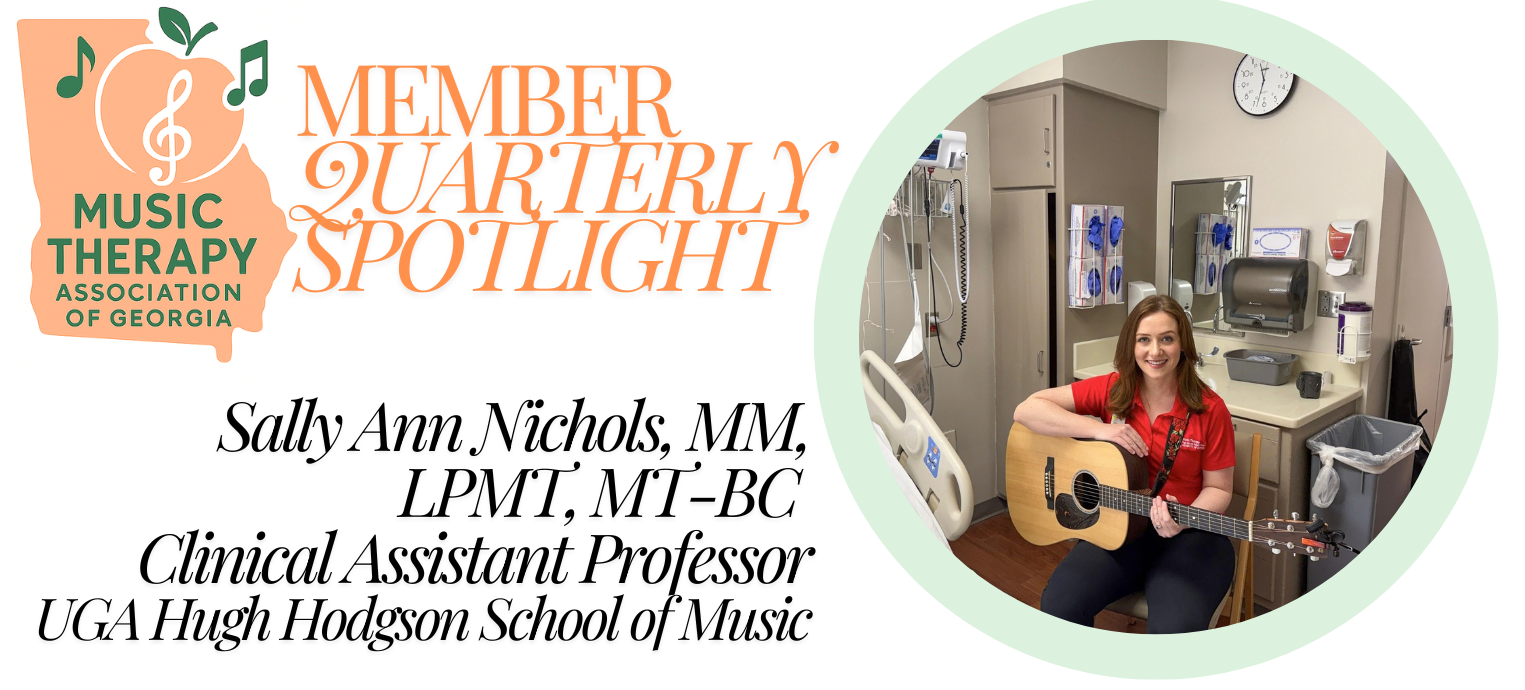
Describe your career as a music therapist—education, populations served, etc.
I am a native of the North Georgia mountains right on the Tennessee line, so I went up to Nashville for my undergrad at Belmont (I was in their first music therapy graduating class!). I completed internship at Tallahassee Memorial Healthcare then stayed for my master’s at Florida State. While in my master’s, I worked private practice in early childhood, autism, and special needs and was also the graduate assistant at TMH. Once graduating, I landed at a job working for the Air Force at Eglin AFB in Fort Walton Beach, FL. I specialized in working with active-duty military service members with traumatic brain injury and PTSD at a specialized treatment center called the Intrepid Spirit Center. The pandemic made us want to make a change, so from there we moved to Birmingham, AL and I worked at UAB Medicine as a medical music therapist. I worked all across the hospital, including in the NICU and psychiatrics, but my favorite units were trauma and neuro. In 2022 I joined the faculty at UGA and was so excited to get back to my home state and closer to family! I’m a clinical faculty, which means most of my week is still in the field doing music therapy with students. I’m currently supervising at our two hospitals here in Athens and also with a local agency doing groups for folks recovering from substance use disorders.
What brought you to the field of music therapy or why did you decide to pursue music therapy as a profession?
Rehabilitation and accessibility have always been part of my life. My dad lived with a spinal cord injury and used a wheelchair my entire life, so I have seen firsthand how challenging navigating the world can be when you have a disability. When I went to college I thought I wanted to work in the music business, but I quickly realized that was NOT the path for me. Like most MTs, I wanted to combine my knowledge from lived experience, desire for service, and musical talents into a career, so music therapy was obviously the answer.
What suggestions do you have for novice music therapists?
Try to find a healthy balance of acceptance that you will never know everything, but also never stop learning. Growth doesn’t end once you have that MT-BC credential, but it’s easy to get overwhelmed realizing that you don’t have all the answers. It’s normal—try to enjoy the learning journey!
What are some of your favorite resources (Websites, books, blogs, journals, etc.)?
Books books books. My current favorite MT text is Music Therapy in Mental Health for Illness Management and Recovery from Michael Silverman. I’ve also always returned to An Introduction to Music Therapy: Theory and Practice, 3rd Edition by Thaut, Gfeller, and Davis (which I think they’ve stopped printing... so sad).
Tell us about one of your most favorite moments of being a music therapist.
I would love to tell you about a specific, life-changing moment, and of course I’ve had beautiful ones, but instead I’d like to take this space to send out some encouragement. I think we can get caught up in those highlight “music therapy moments” that you see on social media and we forget that change still happens in the mundane and repetitive. We’ve all had those sessions where we didn’t see much progress or change, or we felt like we really didn’t do anything. I think it’s important to remember that those moments also still matter, and that neuroplasticity is still happening even though we can’t see it!
Describe a challenge you have had in your career and what you did to overcome it.
At one of our clinical sites, the role of music therapy was very misunderstood due to some volunteer work. I constantly felt patronized and invalidated. To overcome, it was helpful for me to think through what our scope of practice really includes and change the language of how I was introducing music therapy to ensure that patients, other therapists, nurses, and leadership understood. I also had to overcome any intimidation of talking with leadership at that clinical site to advocate for patient safety. They listened and the problem was solved! All it took was someone to speak up. Let’s be real for a second though—advocacy fatigue is real and exhausting.
What goals do you have for the next few years?
My passion is medical music therapy, specifically adult medical, and this is a huge gap in the type of services that are provided in our state. I hope through our current partnerships we can continue to advocate and expand medical music therapy in GA!
Do you have hobbies outside of music?
Of course! I love gardening and growing herbs, painting very mid landscapes, traveling (I spent an entire month between Italy and Scotland this past summer), yoga, literally anything outside, and annoying my two cats, Fanny and Flossie, and husband, Matthew.
Why are you a member of MTAG?
Because connection is important! Our culture is so isolated and individualistic that we forget that our psychosocial needs are incredibly important. Music therapists often feel even more isolated because we’re often misunderstood or the only one. The more we can get to know each other and support each other through advocacy or community events, the better we can be to serve our state!
What else would you like us to know about you?
I LOVE to connect with music therapists in Georgia, and I truly want to grow access to MT in our state! Please reach out and let’s talk, especially if you need a sounding board for an idea. My email is sallyannnichols@uga.edu.