
Quarterly Member Spotlight
2025, Quarter 3
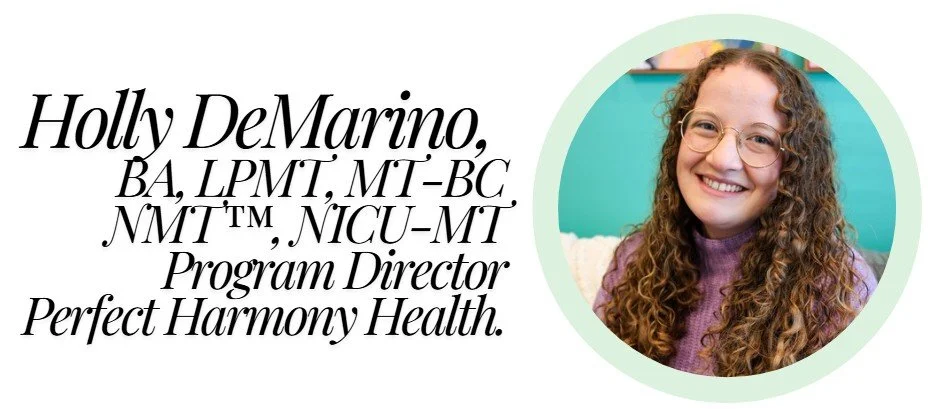
Describe your career as a music therapist - education, population served, etc.
My journey as a music therapist began at the University of Georgia, where I earned my bachelor’s degree in music therapy. After completing a six-month internship in pediatric music therapy with Therabeat Inc., I joined their team as a full-time therapist in 2019.
During the pandemic, I transitioned into mental health, working in crisis stabilization with adults, children, and teens across two facilities over the course of three years. This experience also gave me the opportunity to step into leadership as an Activity Director.
In 2023, I joined Perfect Harmony Health, where I now serve as Program Director and music therapist. I provide services for individuals of all ages through both group sessions and one-on-one work, helping foster growth, connection, and healing through music. I also oversee all of our summer and year-round programs.
What brought you to the field of music therapy or why did you decide to pursue music therapy as a profession?
Like many in our profession, I grew up surrounded by music. I was a part of many choirs, music theater productions, and instrumental ensembles throughout my life. However, I didn't see it as a feasible career choice until I overheard a conversation between my church choir director and her daughter. She mentioned that she should apply to the music therapy program at the University of Georgia. I immediately went home and did a deep dive on Google and found the AMTA website. From then on, my purpose was set. Not only did I want to be a music therapist, but I also wanted to bring music therapy to rural communities like the one I was raised in.
What suggestions do you have for a novice music therapist?
Find a community of people to support you clinically. So much of my confidence as a music therapist has developed by being saturated in surrounding myself with therapists of different modalities, experience levels, and backgrounds. Keep an open mind and know that it's okay not to know it all, but to be in constant pursuit of informed best practice.
What are some of your favorite resources?
Currently, I'm on a big cognitive neuroscience reading kick. I've bought tons of nursing study guides for areas of the brain and their function. I'm reading The Cognitive Neurosciences Sixth Edition, as well as the Neurologic Music Therapy Handbook. I also highly recommend reading The Body Keeps the Score by Bessel A. Van Der Kolk and It Didn't Start with You, by Mark Wolynn to inform your practice with any diagnosis. My favorite Blog currently is Noah Seback's "Quirk Thrives With Noah."
Tell us about one of your most favorite moments of being a music therapist.
I've had so many favorite moments in my career, and it's really hard to choose. My favorite right now is being able to collaborate with some of my non-speaking young adults on their treatment plans via spell to communicate. This one client in particular has moved from being more passive about his goals and objectives to editing them to his desired difficulty. It makes me so proud and honored to provide a space for choice when normally there isn't.
Describe a challenge you have had in your career and what you did to overcome it.
COVID was a huge challenge to my career. My client load plummeted, and it was an isolating time for me. I nearly left the field, but luckily, I had a great support system at home. It was very important for me to make sure that I was taking care of myself by going to therapy and doing meaningful tasks outside of work. This ultimately kept me from burning out.
What goals do you have for the next few years?
My goal is to increase my recall skills in all areas of the brain. I would love to get my masters in cognitive neuroscience. I want to help grow Perfect Harmony Health and continue to make music therapy more accessible to underserved populations.
Do you have hobbies outside of music?
So many! I'm a huge fan of cozy games such as Stardew Valley and Harvest Moon. My husband and I love traveling to National Parks and exploring Atlanta's many hiking trails. I also have some other creative pursuits like embroidery and cross-stitching that keep me busy.
Why are you a member of MTAG?
I'm a member of MTAG because it's important to stay connected to your music therapy tribe. Not only because community is important, but because your colleagues hold you accountable for best practice and can give you new ideas for interventions!
What else would you like us to know about you?
I just love my job so much, and I feel honored to be here.